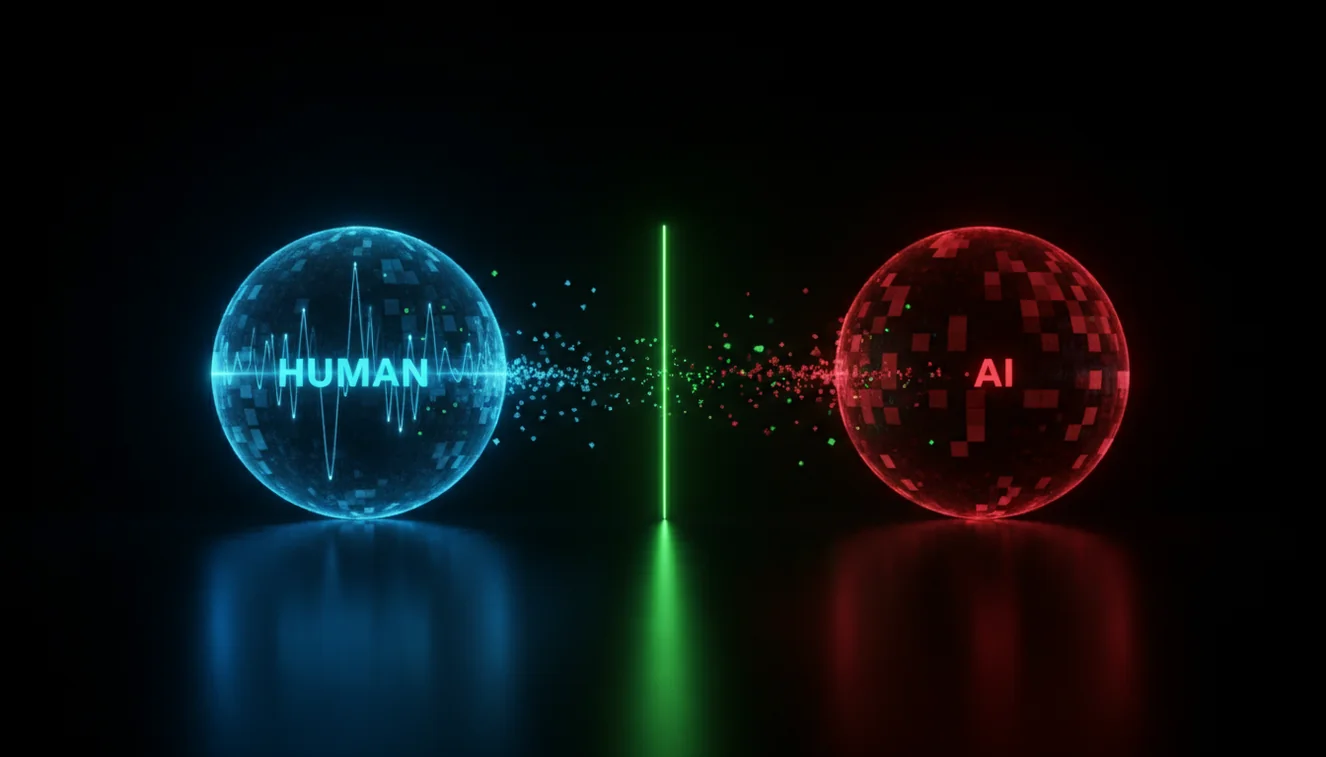
What Is an AI Detector
An AI detector is a tool that analyzes written text to determine whether it was authored by a human or generated by an artificial intelligence model. It evaluates statistical properties of language, including perplexity, burstiness, and token probability, to classify content as human-written or machine-generated. AI detectors do not read text for meaning. They measure how predictable each word choice is within the context of surrounding words.
In practice, if you've spent any real time comparing AI drafts against human writing, the differences aren't always obvious at first glance. AI text tends to hit a certain rhythm — paragraphs that are roughly the same length, transitions that never stumble, a strange absence of the small imperfections that make writing feel lived-in. An experienced editor can often sense it before any tool confirms it. The vocabulary stays in a narrow band of "safe" word choices. Sentences begin with similar structures. There's a polish to it that paradoxically makes it less convincing.
AI detectors exist because the volume of machine-generated content has grown exponentially since 2023. Educators, publishers, hiring managers, and content platforms all need reliable ways to distinguish between human authorship and AI output. The challenge is real and evolving — as language models improve, detection methods must adapt alongside them.

How AI Detection Works
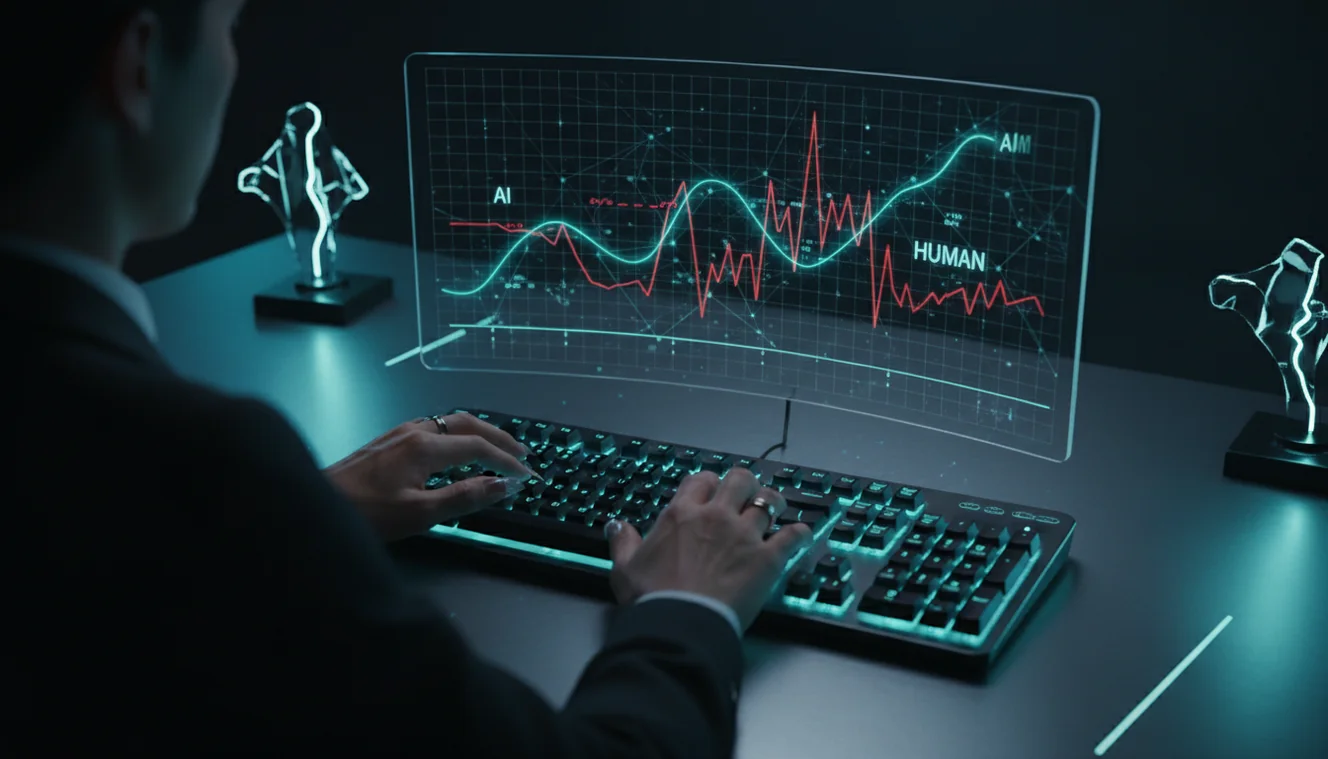
AI detection relies on measuring two primary features of text: perplexity and burstiness. Perplexity measures how surprising or unpredictable a sequence of words is. Human writing tends to have higher perplexity because people make unexpected word choices, use idioms, and occasionally break grammatical conventions. AI-generated text tends toward lower perplexity because language models select statistically likely word sequences.
Burstiness measures variation in sentence complexity. Humans naturally mix short, punchy sentences with longer compound ones. We digress. We circle back. AI models, especially without explicit prompting for variation, tend to produce sentences of similar length and complexity throughout a piece.
Beyond these core metrics, modern AI checkers also look at token-level probability distributions, n-gram frequency patterns, and stylistic consistency. Some tools use classifier models trained on large datasets of confirmed human and AI text. The detection process happens in seconds, but the underlying math involves comparing millions of statistical data points against known signatures of machine-generated language.
One thing worth noting — and this gets lost in marketing claims — is that detection confidence depends heavily on text length. A 300-word sample gives an AI checker far more signal than a 30-word snippet. Short text produces unreliable results regardless of the tool.
What Models AI Detectors Can Identify
Current AI detectors can analyze text generated by most mainstream large language models. This includes GPT-3.5, GPT-4, GPT-4o, and ChatGPT from OpenAI; Gemini and Gemini Pro from Google; Claude and Claude 3 from Anthropic; LLaMA and Mistral from the open-source community; and various other models fine-tuned for specific applications.
Detection accuracy varies across models. Older models like GPT-3.5 produce text with more detectable patterns. Newer models like GPT-4o and Claude 3 generate output that's harder to flag because they've been trained to produce more natural-sounding language. The length of the text sample matters too — anything under 100 words significantly reduces confidence in the results.
Limitations and Accuracy
No AI detector is 100% accurate. This is a fundamental constraint of the technology, not a flaw in any specific tool. AI detectors provide probabilistic assessments, not binary judgments. A result showing "85% likely AI-generated" means the text exhibits patterns strongly associated with machine output, but certainty is not possible.
False positives happen. Technical writing, legal documents, and non-native English writing can sometimes trigger AI detection because they share characteristics with machine-generated text — low burstiness, predictable structure, limited vocabulary range. False negatives also occur when AI text has been substantially edited by a human or generated with specific prompts designed to mimic natural writing.
AI detection results should be used as one data point among many, not as the sole basis for consequential decisions. Academic institutions, publishers, and employers should combine AI detection with other forms of assessment when evaluating authorship.