What Is a Text Summarizer
A text summarizer is a tool that reduces longer content into shorter versions while retaining the essential information and main ideas. Summarizers help readers quickly grasp the core message of articles, reports, essays, and other documents without reading the full text. They are used by students preparing for exams, professionals scanning industry reports, researchers reviewing literature, and anyone who needs to process large amounts of written content efficiently.
Traditional summarization relied on extractive methods: selecting key sentences from the source and stitching them together. Modern AI summarizers use abstractive approaches, generating new sentences that convey the same meaning. This produces more fluent, coherent summaries that read like human-written condensations rather than cut-and-paste excerpts. The best summarizers balance brevity with completeness — capturing the main arguments, supporting evidence, and critical details without introducing distortion.
AI summarizers are built on large language models trained on vast amounts of text. They learn to identify what matters in a document: the thesis, key claims, important examples, and conclusions. When you input text, the model processes it, weighs the significance of different parts, and produces a condensed version. Many tools allow you to control summary length as a percentage of the original, giving you flexibility for different use cases. Whether you need a one-paragraph overview or a more detailed summary, a good text summarizer adapts to your needs.

How AI Summarization Works
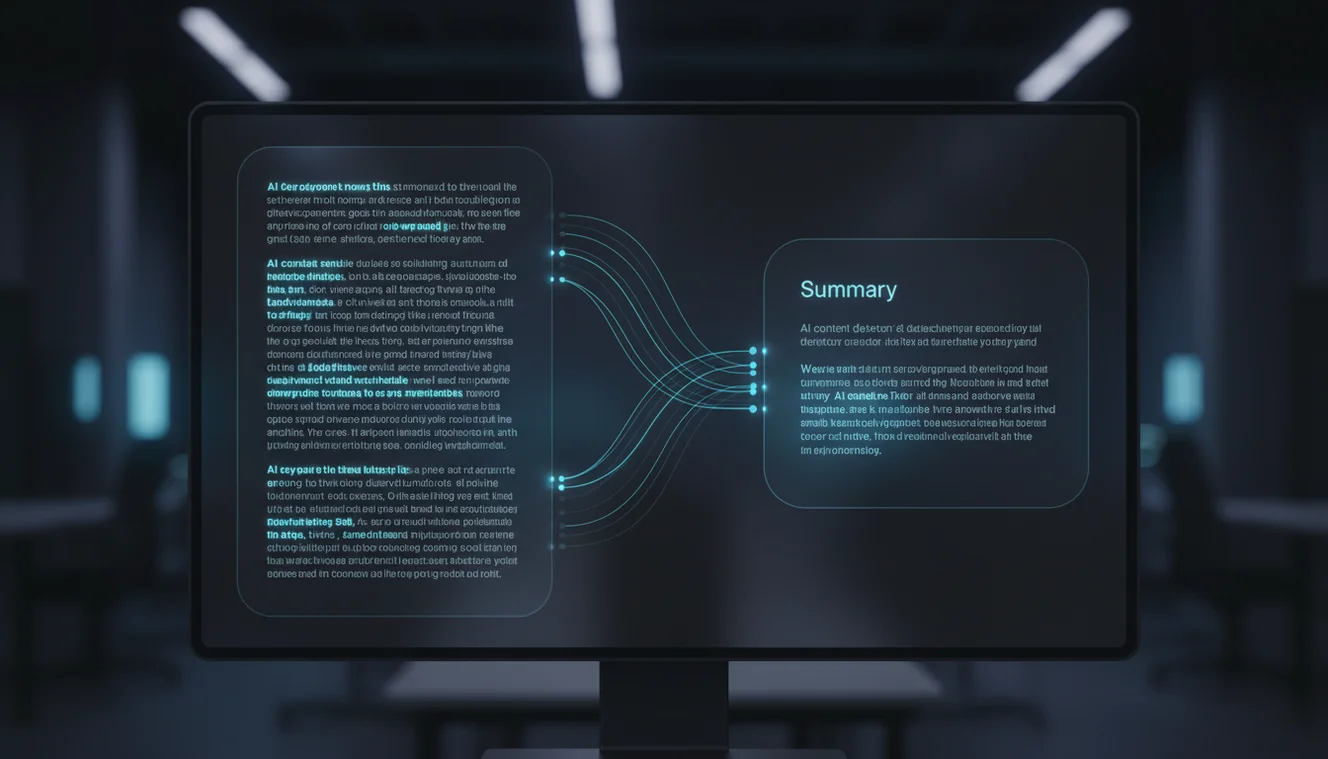
AI summarization involves several stages. First, the model tokenizes and encodes the input text, building an internal representation of its structure and meaning. It identifies main topics, key entities, and the logical flow of arguments. Attention mechanisms allow the model to focus on the most salient parts of the text while downweighting redundant or tangential content. The model then generates new text that compresses this information into a shorter form.
Summary length is a critical parameter. Shorter summaries (e.g., 10–15% of the original) force greater compression and may omit supporting details. Longer summaries (e.g., 35–50%) retain more nuance and context. The ideal setting depends on your purpose. A quick skim of a news article might warrant a 10% summary; study notes for an exam might need 30% or more to capture enough detail for recall.
Quality varies with input. Well-structured text with clear headings and logical flow tends to summarize better. Dense technical writing, poetry, or highly ambiguous content can challenge summarizers. The model may oversimplify complex arguments or miss subtle distinctions. For critical applications, always review the summary against the original to ensure accuracy.
Use Cases for Text Summarization
Students use summarizers to condense textbook chapters, research papers, and lecture notes. Professionals use them to quickly digest industry reports, competitor analyses, and lengthy emails. Researchers use them to scan literature and identify relevant papers. Content creators use them to generate meta descriptions or social media snippets from longer articles. The common thread is efficiency: reducing reading time while preserving enough information to act or understand.
Summarization also supports accessibility. People with reading difficulties, time constraints, or cognitive overload can benefit from condensed versions. Executives who receive dozens of reports daily can use summarizers to triage and prioritize. The AI Detector and AI Checker on our homepage help you verify whether content was human- or AI-written; summarizers, by contrast, help you process and understand content regardless of its origin.

Limitations of Text Summarizers
Text summarizers have important limitations. They can introduce errors when condensing complex or technical material. Nuance, irony, and subtle argumentation may be lost. Very short summaries risk oversimplification or misrepresentation. AI summarizers can also hallucinate — adding information not present in the source — though this is less common in summarization than in open-ended generation.
Summarizers work best with well-structured, factual text. They may struggle with highly creative writing, legal documents, or content where precise wording matters. For academic or professional use, treat summaries as aids, not substitutes for reading the full text when accuracy is critical. Always verify key facts and claims against the original.
Ethical considerations apply. Using AI summaries to avoid reading assigned material may violate academic integrity. Submitting summarized content as original work without attribution can constitute plagiarism. Summarizers are tools to support understanding and efficiency; they should not replace engagement with source material when depth is required.